
[01]
// CASE STUDY
Chapters
The
Story
Problem
Most digital wellbeing platforms prioritise content volume over impact. Users often consume videos, articles or podcasts passively, without pausing to reflect or apply what they’ve learned to real life. Interfaces are typically noisy, driven by infinite feeds and engagement loops that overwhelm rather than support introspection. Meaningful discussion is either absent or reduced to surface-level reactions, leaving users without safe spaces to process insights together. The core challenge with Telos was to design a wellbeing platform that encourages intentional self-improvement rather than passive content consumption.
Solution overview
Telos combines curated video content, reflection-driven discussions and long-form learning formats to support personal growth. The product is designed around three principles: depth over speed, reflection over reaction, and community insight over algorithms. Rather than pushing constant consumption, the platform keeps the environment calm and focused, inviting users to slow down and engage thoughtfully with the content and with each other.
Challenges & trade-offs
Avoiding content overload. Instead of infinite feeds, Telos relies on curation and recommendations.
Encouraging thoughtful discussion. Social metrics were intentionally minimised to keep conversations reflective, not performative.
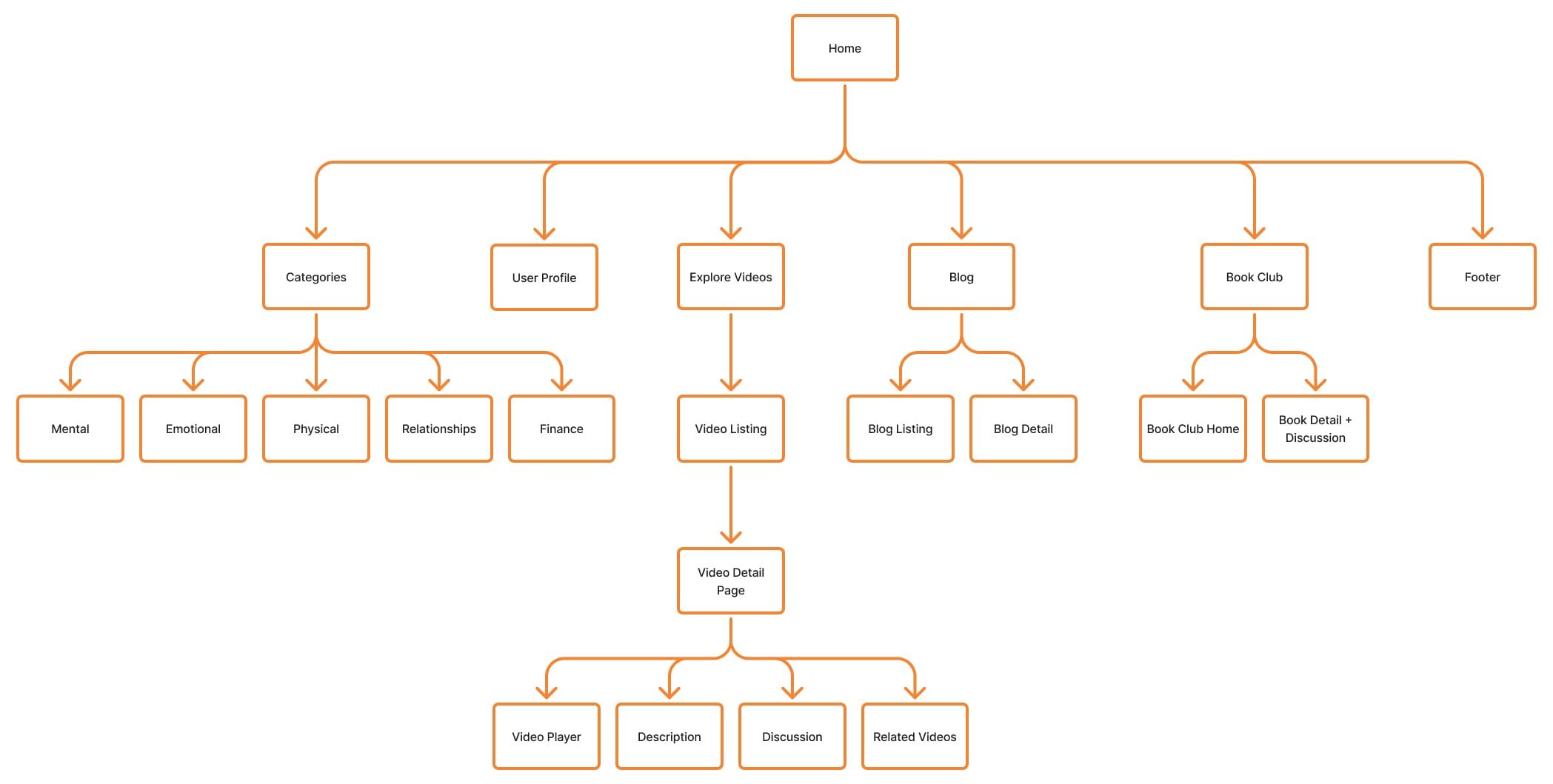
Balancing depth with discoverability. The information architecture was kept shallow and clear to reduce cognitive load while still supporting exploration.
Outcome
Navigation is organised by area of life, so users start from a goal rather than a feed, and discussion sits directly alongside each piece of content. The project reinforced a lesson I carry into other work: wellbeing products benefit from slowing users down rather than optimising for speed or volume, and intentional design can encourage healthier digital habits.

